A cleaner & simpler example of a 2-state/2-choice problem is the Uzawa-Lucas model.

A special case (full depreciation & log utility) has a closed form solution:

The Euler equations if \gamma =0 (no externality)
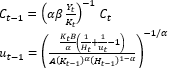
Now in Julia
using Interpolations, Plots, LinearAlgebra, SpeedMapping
@inline approx(gr, val0) = LinearInterpolation(gr, val0, extrapolation_bc = Line())
#
α=.33; β=.97; #σ=1;δ=0;A=1.0;
F(K,H,u;α=α) = (K^α)*(u^(1-α))*(H^(1-α))
#
γ=0.0;
ū=((1-α)*(1-β))/(1-α+β*γ)
B= 1/(1.0 - ū) + .02
#B= 1/(1.0 - ū) - .02
#B= 1/(1.0 - ū)
#
S1 = [(.01 : .01 : 1.0);]
S2 = [(.01 : .01 : 1.0);]    #S = [S1 S2]  PolyBasis(S1, S2)
#
T1(s1,s2,c1,c2) = F(s1,s2,c2) -c1
T2(s1,s2,c1,c2; B=B) = B*(1-c2)*s2
#
c1_EE1(s1,s2,s1p,s2p,c1p,c2p; α=α,β=β) = c1p*((β*α*(F(s1p,s2p,c2p)/s1p))^(-1))
c1_min(s1,s2) = 0.00001      # c1 >= 0.0
c1_max(s1,s2) = F(s1,s2,1.0) # c1 <=
#
c2_EE2(s1,s2,s1p,s2p,c1p,c2p;B=B,α=α) = ((s1p*B/α)*(1/s2p +1/c2p -1)/((s1^α)*(s2^(1-α))))^(-1/α)
c2_min(s1,s2) = 0.0
c2_max(s1,s2) = 1.0
#
EE1(s1,s2,s1p,s2p,c1p,c2p) = clamp(c1_EE1(s1,s2,s1p,s2p,c1p,c2p), c1_min(s1,s2), c1_max(s1,s2))
EE2(s1,s2,s1p,s2p,c1p,c2p) = clamp(c2_EE2(s1,s2,s1p,s2p,c1p,c2p), c2_min(s1,s2), c2_max(s1,s2))
#
Π10 = [(1-α*β)*F(s1,s2,ū) for s1 in S1, s2 in S2] #
Π20 = [ū for s1 in S1, s2 in S2] #
#
function FPI_EE_map!(Π1p, Π2p, Π1, Π2, S1, S2)
    #
    Π1h = approx((S1, S2), Π1)
    Π2h = approx((S1, S2), Π2)
    S1p = [T1(S1[j], S2[k], Π1[j,k], Π2[j,k]) for j in eachindex(S1), k in eachindex(S2)]
    S2p = [T2(S1[j], S2[k], Π1[j,k], Π2[j,k]) for j in eachindex(S1), k in eachindex(S2)]
    C1p = [Π1h(S1p[j,k], S2p[j,k]) for j in eachindex(S1), k in eachindex(S2)]
    C2p = [Π2h(S1p[j,k], S2p[j,k]) for j in eachindex(S1), k in eachindex(S2)]
    Π1p .= [EE1(S1[j], S2[j], S1p[j,k], S2p[j,k], C1p[j,k], C2p[j,k]) for j in eachindex(S1), k in eachindex(S2)]
    Π2p .= [EE2(S1[j], S2[j], S1p[j,k], S2p[j,k], C1p[j,k], C2p[j,k]) for j in eachindex(S1), k in eachindex(S2)]
end
#res = speedmapping(Π10,Π20; (m!)=(Π1p, Π2p, Π1, Π2) -> FPI_EE_map!(Π1p, Π2p, Π1, Π2, S1, S2)) #, tol=1e-10
@inline function FPI_EE(S1, S2, Π1, Π2; k_max=100, tol=0.001)
    dist = 10.0; k=1;
    Π1p = similar(Π1)
    Π2p = similar(Π2)
    @inbounds while(dist > tol && k<=k_max)
        println(k)
        #
        Π1h = approx((S1, S2), Π1)
        Π2h = approx((S1, S2), Π2)
        S1p = [T1(S1[j], S2[k], Π1[j,k], Π2[j,k]) for j in eachindex(S1), k in eachindex(S2)]
        S2p = [T2(S1[j], S2[k], Π1[j,k], Π2[j,k]) for j in eachindex(S1), k in eachindex(S2)]
        C1p = [Π1h(S1p[j,k], S2p[j,k]) for j in eachindex(S1), k in eachindex(S2)]
        C2p = [Π2h(S1p[j,k], S2p[j,k]) for j in eachindex(S1), k in eachindex(S2)]
        Π1p .= [EE1(S1[j], S2[j], S1p[j,k], S2p[j,k], C1p[j,k], C2p[j,k]) for j in eachindex(S1), k in eachindex(S2)]
        Π2p .= [EE2(S1[j], S2[j], S1p[j,k], S2p[j,k], C1p[j,k], C2p[j,k]) for j in eachindex(S1), k in eachindex(S2)]
        #
        dist = 0.5*norm(Π1 - Π1p) + 0.5*norm(Π2 - Π2p)
        k += 1
        Π1 = Π1p
        Π2 = Π2p
    end
    return Π1, Π2 #, va
end
@time Pol1_EE, Pol2_EE = FPI_EE(S1, S2, Π10, Π20; k_max=600, tol=0.000001)
Strangely, plugging in the closed form solution as my guess doesn’t seem to converge…