# Receive the success status of \`push!(Set, element)\`
**URL:** https://discourse.julialang.org/t/receive-the-success-status-of-push-set-element/130988
**Category:** New to Julia
**Tags:** question, set
**Created:** [July 24, 2025, 12:30am UTC](https://discourse.julialang.org/t/receive-the-success-status-of-push-set-element/130988 "2025-07-24T00:30:05Z")
**Posts on this page:** 20
**Page:** 1
### Author:  [@WalterMadelim](https://discourse.julialang.org/u/WalterMadelim)
#### Post date: [July 24, 2025, 12:30am UTC](https://discourse.julialang.org/t/receive-the-success-status-of-push-set-element/130988/1 "2025-07-24T00:30:05Z")
I can push! an element to a Set.
```julia
julia> S = Set();
julia> e = 1;
julia> push!(S, e)
Set{Any} with 1 element:
1
```
But I am not aware of a straightforward way to understand if the element `e` was new to `S`.
Therefore I wrote a function myself
```julia
julia> function push_and_get_status!(S, e)
l = length(S)
push!(S, e)
length(S) == l && return false
return true
end
push_and_get_status! (generic function with 1 method)
julia> push_and_get_status!(S, 2)
true
julia> S
Set{Any} with 2 elements:
2
1
julia> push_and_get_status!(S, true)
false
julia> S
Set{Any} with 2 elements:
2
true
```
I want to know if there is an established more straightforward method?
---
### Author:  [@WalterMadelim](https://discourse.julialang.org/u/WalterMadelim)
#### Post date: [July 24, 2025, 12:45am UTC](https://discourse.julialang.org/t/receive-the-success-status-of-push-set-element/130988/2 "2025-07-24T00:45:47Z")
One additional thing I happen to discover, which I find weird, is
- why is `1` replaced by `true`?
You see, `1 == true`, i.e. when we have owned an equivalent element `1` in `S`, **why do we need to spend the additional effort to replace `1` with `true`**? This is unexpected and doesn’t seem rational.
Just like in statistical tests. If there is a primal hypothesis, my inclination is to trust it. Only after I can testify its invalidness, then I might reject it.
---
### Author:  [@NonDairyNeutrino](https://discourse.julialang.org/u/NonDairyNeutrino)
#### Post date: [July 24, 2025, 12:57am UTC](https://discourse.julialang.org/t/receive-the-success-status-of-push-set-element/130988/3 "2025-07-24T00:57:13Z")
You can just use `in`! Even as a one-liner:
```julia
push_and_get_status!(S, e) = e in S ? false : (push!(S, e); true)
```
---
### Author:  [@Benny](https://discourse.julialang.org/u/Benny)
#### Post date: [July 24, 2025, 12:57am UTC](https://discourse.julialang.org/t/receive-the-success-status-of-push-set-element/130988/4 "2025-07-24T00:57:20Z")
> [@WalterMadelim](#):
>
> ```julia
> l = length(S)
> push!(S, e)
>
> ```
> [@WalterMadelim](#):
>
> straightforward way to understand if the element `e` was new to `S`.
Since you’re starting your check prior to the `push!`, you could’ve checked `e in S` beforehand. It takes longer than a couple `length(S)` calls, but the option to skip `push!` altogether saves more time overall. Benchmarking your method against NonDairyNeutrino’s with `BenchmarkTools.@btime`, I get a savings from 12.4ns to 7.2ns.
> [@WalterMadelim](#):
>
> why is `1` replaced by `true`?
`Set` and the underlying `Dict` compare elements/keys by `isequal`. `isequal(true, 1)` is true, so those values override each other. `IdDict` and `IdSet` use `===` instead, so they don’t have this issue. You’re right that a set could have opted out of replacing an equal key, but it wouldn’t save much work because the hash, search, and comparison already happened by that point, and the `Dict` implementation doesn’t assume or check for an equal value before replacement.
---
### Author:  [@WalterMadelim](https://discourse.julialang.org/u/WalterMadelim)
#### Post date: [July 24, 2025, 1:17am UTC](https://discourse.julialang.org/t/receive-the-success-status-of-push-set-element/130988/5 "2025-07-24T01:17:21Z")
So, my point is, why can’t
```julia
push_and_get_status!(S, e) = e in S ? false : (push!(S, e); true)
```
replace the current julia’s `push!(S::Set, e)` method (which returns `S`).
I think your method `push_and_get_status!(S, e)` will be more useful in practice.
And I don’t think `e in S` is a disjoint operation to the underlying realization of `push!(S::Set, e)`.
---
### Author:  [@Benny](https://discourse.julialang.org/u/Benny)
#### Post date: [July 24, 2025, 1:22am UTC](https://discourse.julialang.org/t/receive-the-success-status-of-push-set-element/130988/6 "2025-07-24T01:22:52Z")
> [@WalterMadelim](#):
>
> replace the current julia’s `push!(S::Set, e)` method (which returns `S`)
It wasn’t hard to write `push_and_get_status!`, and we still have access to the simpler `push!`. We lose options if we replace simpler building blocks with convenient functions, and convenient functions are only worth adding to the API if it’s difficult to implement well.
---
### Author:  [@WalterMadelim](https://discourse.julialang.org/u/WalterMadelim)
#### Post date: [July 24, 2025, 1:27am UTC](https://discourse.julialang.org/t/receive-the-success-status-of-push-set-element/130988/7 "2025-07-24T01:27:45Z")
> [@NonDairyNeutrino](#):
>
> `push_and_get_status!(S, e) = e in S ? false : (push!(S, e); true)`
So you mean that this function has no redundancy. If this is true, then this topic is accomplished. Thanks!
---
### Author:  [@Benny](https://discourse.julialang.org/u/Benny)
#### Post date: [July 24, 2025, 1:31am UTC](https://discourse.julialang.org/t/receive-the-success-status-of-push-set-element/130988/8 "2025-07-24T01:31:14Z")
I didn’t comment on that, and that definitely does have redundancy. If `e in S` is true, it branches to `push!(S, e)` that performs the same hash, search, and comparison. It’s possible that the compiler might have inlined the two and removed the redundancy, but normally we just `push!` and accept overriding with the most “updated” value or use `IdSet` if we really need the distinction. In the case where we either must `push!` or we expect to hit the `push!` branch most of the time, your `length` checks would be cheaper (my earlier benchmark mention uses the same element the whole time, so it hit the `false` branch).
---
### Author:  [@WalterMadelim](https://discourse.julialang.org/u/WalterMadelim)
#### Post date: [July 24, 2025, 1:41am UTC](https://discourse.julialang.org/t/receive-the-success-status-of-push-set-element/130988/9 "2025-07-24T01:41:11Z")
My original opinion is: the current julia’s `push!` is programmer-oriented, rather than user-oriented.
As a user, the desired `push!(S::Set, element)` should first check if the `element` is new to `S`, if it is not new, then just return `false` (the realistic meaning is that—given I’ve owned, I don’t want to spare an additional operation to do a swap). If the `element` is indeed new to `S` (which equates to `element ∉ S`), then we properly add `element` to `S`, so that the cardinality of `S` is increased by `1`.
> [@Benny](#):
>
> accept overriding with the most “updated” value
I don’t think this overriding is meaningful in practice. Does it?
---
### Author:  [@Benny](https://discourse.julialang.org/u/Benny)
#### Post date: [July 24, 2025, 2:06am UTC](https://discourse.julialang.org/t/receive-the-success-status-of-push-set-element/130988/10 "2025-07-24T02:06:00Z")
> [@WalterMadelim](#):
>
> As a user, the desired `push!(S::Set, element)`
But consider that `push!` is a function for arbitrary collections, and calls with the same arity share as much behavior as possible despite dispatching to different methods based on type. So, if the behavior for `push!(C, e)` is to return a boolean value based on whether the element is new, it has to do that for any collection for no real gain. Checking whether an element was new in a `Vector` is expensive, and `push!` always increases the length. I should’ve clarified earlier, but a separate function specifically for `Set` is more appropriate for what you want.
> [@WalterMadelim](#):
>
> I don’t think this overriding is meaningful in practice. Does it?
It could be; of all the equivalent values ever `push!`-ed into a set, the latest one is more often the preferred outcome than the earliest one. Even before considering whether it’s practical, inserting the input is the documented behavior of `push!`. “Insert unless it already exists” is something else that saves little work, and it’s more work for dictionaries where there’s an associated value to also compare.
---
### Author:  [@WalterMadelim](https://discourse.julialang.org/u/WalterMadelim)
#### Post date: [July 24, 2025, 2:28am UTC](https://discourse.julialang.org/t/receive-the-success-status-of-push-set-element/130988/11 "2025-07-24T02:28:31Z")
> [@Benny](#):
>
> Checking whether an element was new in a `Vector` is expensive
So you mean that if I define
```julia
mypush!(S, e) = e ∈ S ? false : (push!(S, e); true);
```
Then doing this
```julia
julia> S = Set(); # Set
julia> for i = 1:10000
mypush!(S, i)
end
julia> mypush!(S, true)
false
```
is better than (more efficient than) the Vector counterpart (as follows)?
```julia
julia> S = []; # Vector
julia> for i = 1:10000
mypush!(S, i)
end
julia> mypush!(S, true)
false
```
(Note that both code snippet can achieve my aim, and the latter `Vector` arrangment appears more convenient.)
---
### Author:  [@Benny](https://discourse.julialang.org/u/Benny)
#### Post date: [July 24, 2025, 2:30am UTC](https://discourse.julialang.org/t/receive-the-success-status-of-push-set-element/130988/12 "2025-07-24T02:30:55Z")
Way more, O(1) vs O(n) because of the `e ∈ S` part. It’s why we use `Set` at all, though you might only observe performance gains at larger lengths. Also note that the check and branch is necessary for this maybe-push behavior in the `Vector` case; the `length` checks with mandatory `push!` would not work.
---
### Author:  [@WalterMadelim](https://discourse.julialang.org/u/WalterMadelim)
#### Post date: [July 24, 2025, 3:52am UTC](https://discourse.julialang.org/t/receive-the-success-status-of-push-set-element/130988/13 "2025-07-24T03:52:25Z")
I opened an issue [A more user-friendly function enhancing the `push!(S::Set, element)` method? · Issue #59084 · JuliaLang/julia · GitHub](https://github.com/JuliaLang/julia/issues/59084)
---
### Author:  [@Benny](https://discourse.julialang.org/u/Benny)
#### Post date: [July 24, 2025, 4:27am UTC](https://discourse.julialang.org/t/receive-the-success-status-of-push-set-element/130988/14 "2025-07-24T04:27:01Z")
Can’t speak for anyone involved, but my guess is that won’t go anywhere because a new function could be in an independent package. The current movement is to reduce the system image (load fewer standard libraries at startup, instead load them upon first import like other packages), and adding more functions to the already imported `Base` is an _irreversible_ motion in the opposite direction. Based on adjacent discussions, the first thing they’ll do if v2 ever starts serious development is move as much as possible from `Base` into standard libraries.
---
### Author:  [@WalterMadelim](https://discourse.julialang.org/u/WalterMadelim)
#### Post date: [July 24, 2025, 5:30am UTC](https://discourse.julialang.org/t/receive-the-success-status-of-push-set-element/130988/15 "2025-07-24T05:30:08Z")
I took a look. It seems that the APIs on `Set` are far from cumbersome. I think such a special method for `Set` is useful. And I think a proper name is `collect!(S, e)::Bool`, not knowing whether appropriate🥲
---
### Author:  [@DNF](https://discourse.julialang.org/u/DNF)
#### Post date: [July 24, 2025, 6:47am UTC](https://discourse.julialang.org/t/receive-the-success-status-of-push-set-element/130988/16 "2025-07-24T06:47:44Z")
> [@WalterMadelim](#):
>
> My original opinion is: the current julia’s `push!` is programmer-oriented, rather than user-oriented.
Since Julia is a programming language, all users are by definition programmers. I’ve seen people claim this distinction before, and it doesn’t make sense to me.
I also don’t understand why a ‘user’ would want the status returned, but a ‘programmer’ would not.
---
### Author:  [@jakobnissen](https://discourse.julialang.org/u/jakobnissen)
#### Post date: [July 24, 2025, 6:51am UTC](https://discourse.julialang.org/t/receive-the-success-status-of-push-set-element/130988/17 "2025-07-24T06:51:42Z")
You are looking for `in!` - this does exactly what you want.
The existing `in` can’t be changed to return a boolean, because that would be a breaking change. The existing behaviour is useful, because it allows you to do stuff like:
```julia
with_element = push!(copy(my_set), element)
```
---
### Author:  [@WalterMadelim](https://discourse.julialang.org/u/WalterMadelim)
#### Post date: [July 24, 2025, 7:14am UTC](https://discourse.julialang.org/t/receive-the-success-status-of-push-set-element/130988/18 "2025-07-24T07:14:54Z")
> [@DNF](#):
>
> I also don’t understand why a ‘user’ would want the status returned
they do. Apparently someone has proposed this idea before me (Since the `in!` function was added in Julia 1.11).
> [@jakobnissen](#):
>
> You are looking for `in!` - this does exactly what you want.
Yes, exactly.
```julia
julia> collect!(S, e) = !in!(e, S)
collect! (generic function with 1 method)
julia> S = Set();
julia> collect!(S, 1) # success? Yes
true
julia> collect!(S, 2) # success? Yes
true
julia> S
Set{Any} with 2 elements:
2
1
julia> collect!(S, true) # success? No
false
julia> S
Set{Any} with 2 elements:
2
1
```
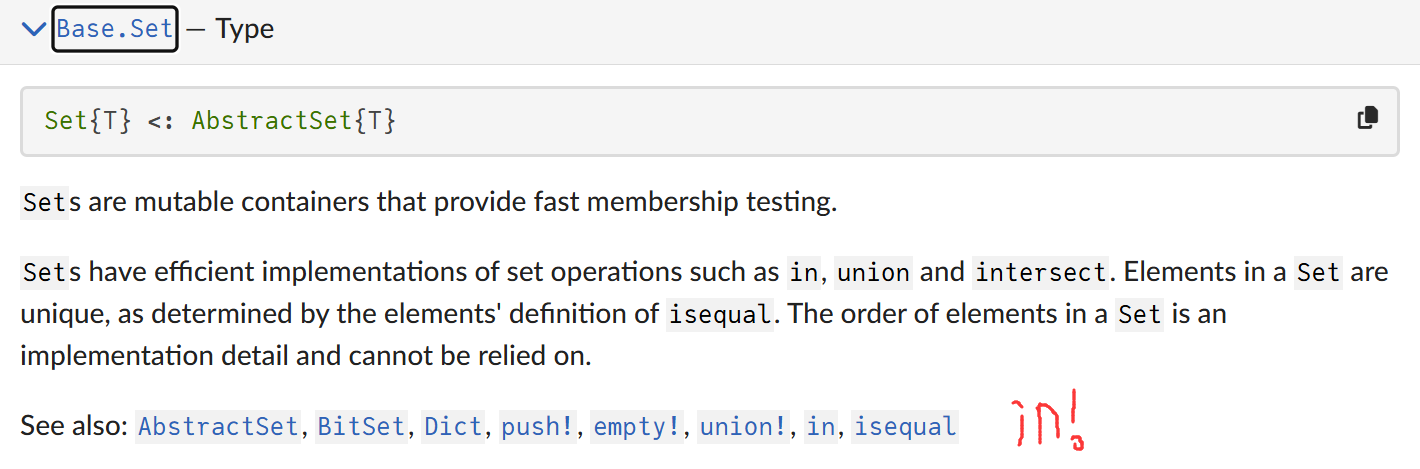
But it might be a pity I cannot spot this `in!` function in the doc.
---
### Author:  [@DNF](https://discourse.julialang.org/u/DNF)
#### Post date: [July 24, 2025, 7:36am UTC](https://discourse.julialang.org/t/receive-the-success-status-of-push-set-element/130988/19 "2025-07-24T07:36:20Z")
> [@WalterMadelim](#):
>
> they do. Apparently someone has proposed this idea before me (Since the `in!` function was added in Julia 1.11).
You cut my sentence in half, I said
> [@DNF](#):
>
> I also don’t understand why a ‘user’ would want the status returned, but a ‘programmer’ would not.
If programmers don’t want the status returned, this wouldn’t be added.
Also, there is a very big difference between wanting status returned from `push!` vs from `in!`, for the latter, when checking `in`, the status is the point.
I was saying I don’t understand why there would be a difference between ‘programmers’ and ‘users’ in this case, and that the distinction is not clear or useful.
---
### Author:  [@WalterMadelim](https://discourse.julialang.org/u/WalterMadelim)
#### Post date: [July 24, 2025, 8:06am UTC](https://discourse.julialang.org/t/receive-the-success-status-of-push-set-element/130988/20 "2025-07-24T08:06:42Z")
> [@Benny](#):
>
> hash, search, and comparison
As Benny said, programmers may focus on these low-level realizations, how they can be done efficiently.
As a user, I only care about the correctness of the logic.
```julia
function collect!(S, e)
e ∈ S && return false # you can NOT strictly enrich `S` by adding `e`
push!(S, e)
return true # You can strictly enrich `S` this time
end
```
For my (optimization) application, the `S` is a set of cuts. As I definitely want to avoiding adding the same cuts to a model
```julia
julia> model = JuMP.Model();
julia> @constraint(model, x[1] + 2x[2] + 3x[3] ≤ 4)
x[1] + 2 x[2] + 3 x[3] <= 4
julia> @constraint(model, x[1] + 2x[2] + 3x[3] ≤ 4) # This is undesired
x[1] + 2 x[2] + 3 x[3] <= 4
julia> print(model)
Feasibility
Subject to
x[1] + 2 x[2] + 3 x[3] <= 4
x[1] + 2 x[2] + 3 x[3] <= 4
```
I can do something like this (my real application code)
```julia
PBus1, PBus2 = ı.(mj[:pBus1]), ı.(mj[:pBus2]) # get the column newly generated
if collect!(cols[j], [PBus1, PBus2]) # this vertex is new
con = JuMP.@build_constraint(θ[j] ≤ ı(mj[:prim_obj]) + β ⋅ (PBus1 + PBus2))
Threads.lock(() -> push!(rows[j], JuMP.add_constraint(model, con)), my_lock)
out_upd_vec[j] = true # indicating we can strictly enrich the model this time
end
```
[Next page](https://discourse.julialang.org/t/receive-the-success-status-of-push-set-element/130988.md?page=2)