# Only trivial solution in BifurcationKit
**URL:** https://discourse.julialang.org/t/only-trivial-solution-in-bifurcationkit/132391
**Category:** Numerics
**Tags:** question, package, bifurcationkit
**Created:** [September 15, 2025, 10:04am UTC](https://discourse.julialang.org/t/only-trivial-solution-in-bifurcationkit/132391 "2025-09-15T10:04:10Z")
**Posts on this page:** 14
**Page:** 1
### Author:  [@acubed](https://discourse.julialang.org/u/acubed)
#### Post date: [September 15, 2025, 10:04am UTC](https://discourse.julialang.org/t/only-trivial-solution-in-bifurcationkit/132391/1 "2025-09-15T10:04:10Z")
I try to investigate pitchfork bifurcation, using the `BifurcationKit`. My problem looks as follow. I start from some definitions:
```julia-auto
ND = 500
dx = 1.0/ND
x = collect(1:ND)*dx.-dx/2
J = +1.0
beta0 = 0.1
u0 = 0.01*ones(Float64,ND)
W = ones(Float64,ND,ND);
function rhs(u, beta)
global J,dx,W
return u - tanh.(J*beta*dx*W*u)
end
```
Then, I introduce bifurcation problem:
```julia-auto
prob = BifurcationKit.BifurcationProblem(rhs, u0, beta0, 1)
```
and use
```julia-auto
opt_newton = BifurcationKit.NewtonPar(tol=1e-9)
opts = BifurcationKit.ContinuationPar(p_min=0.0, p_max=5.0, max_steps=500, dsmax=2.e-2, dsmin=1.e-4, ds=1.e-4, nev=ND, newton_options=opt_newton);
```
I run `continuation` method as follows:
```julia-auto
br = BifurcationKit.continuation(prob, BifurcationKit.PALC(),opts, bothside = true, normC=norm, verbosity=0)
```
I see the correct bifurcation point at p\approx 1 and extract it:
```julia-auto
p_test = br.specialpoint[2].param
```
Then, I try to switch branch:
```julia-auto
test = BifurcationKit.continuation(br, 2, opts; δp = -0.1)
```
My final goal is to obtain 2 vectors `p_values` and `solution_u`. I have tried to extract this solution as `br.sol` or `test.sol`. But everywhere I see only the (seems that) trivial solution. For instance:
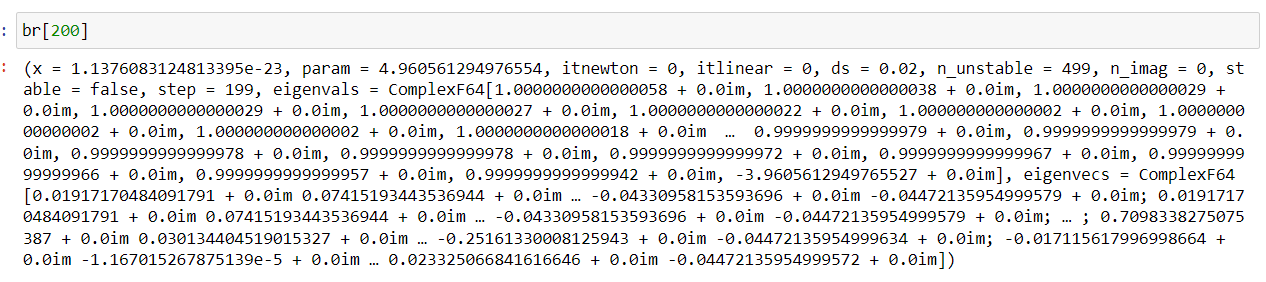
I have tried to manipulate with `record_from_solution`, but it does not give the desired result. I have tried to add:
```julia-auto
record_from_solution = (u,beta; k...) -> (n2=norm(u),solu=u)
```
I have read the documentation, but I still do not understand properly what did I wrong.
---
### Author:  [@rveltz](https://discourse.julialang.org/u/rveltz)
#### Post date: [September 15, 2025, 5:35pm UTC](https://discourse.julialang.org/t/only-trivial-solution-in-bifurcationkit/132391/2 "2025-09-15T17:35:15Z")
> [@acubed](#):
>
> `test = BifurcationKit.continuation(br, 2, opts; δp = -0.1)`
It seems too far from the bifurcation point. This works:
```julia-auto
test = BifurcationKit.continuation(br, 2, opts; δp = -0.01)
```
I am surprised it does not converged though.
---
### Author:  [@rveltz](https://discourse.julialang.org/u/rveltz)
#### Post date: [September 15, 2025, 6:29pm UTC](https://discourse.julialang.org/t/only-trivial-solution-in-bifurcationkit/132391/3 "2025-09-15T18:29:34Z")
> [@acubed](#):
>
> `test = BifurcationKit.continuation(br, 2, opts; δp = -0.1)`
If you use debug mode `ENV["JULIA_DEBUG"] = BifurcationKit`, your code gives:
```julia
┌ Debug: The guess for the amplitude of the first periodic orbit on the bifurcated branch obtained by the predictor is not small: 3.8685530832137087. This may lead to convergence failure of the first newton step or select a branch far from the Hopf point.
│ You can either decrease `ds` or `δp` (which is how far from the bifurcation point you want the branch of periodic orbits to start). Alternatively, you can specify a multiplicative factor `ampfactor` to be applied to the predictor amplitude.
...
```
You have the indication `You can either decrease ds` or `δp` albeit the message is wrong (it is for Hopf bifurcation and I will correct this).
---
### Author:  [@acubed](https://discourse.julialang.org/u/acubed)
#### Post date: [September 17, 2025, 12:05pm UTC](https://discourse.julialang.org/t/only-trivial-solution-in-bifurcationkit/132391/4 "2025-09-17T12:05:23Z")
I definitely need to obtain more intution about \delta p… My final goal is to obtain array of parameter values `p_values` and the mean of solution, i.e. `mean(sol_vector)`, where `sol_vector` represents the solution for given parameter value `p`. What should I do for it?
My naive guess was that I can do it by single run of `BifurcationKit.continuation`, but now I am not sure
---
### Author:  [@rveltz](https://discourse.julialang.org/u/rveltz)
#### Post date: [September 17, 2025, 1:33pm UTC](https://discourse.julialang.org/t/only-trivial-solution-in-bifurcationkit/132391/5 "2025-09-17T13:33:36Z")
> [@acubed](#):
>
> I definitely need to obtain more intution about $\delta p$…
> **[Introduction · Bifurcation Analysis in Julia](https://bifurcationkit.github.io/BifurcationKitDocs.jl/dev/intro-abs/)**
>
> Documentation for Bifurcation Analysis in Julia.
If the library were optimal, you should not have to worry too much about it…
---
### Author:  [@rveltz](https://discourse.julialang.org/u/rveltz)
#### Post date: [September 17, 2025, 1:42pm UTC](https://discourse.julialang.org/t/only-trivial-solution-in-bifurcationkit/132391/6 "2025-09-17T13:42:56Z")
> [@acubed](#):
>
> My final goal is to obtain array of parameter values `p_values` and the mean of solution, i.e. `mean(sol_vector)`
You have several options:
1/ `plot(test.param, [mean sol.x for sol in test.sol])`
2/ pass `record_from_solution = (u,beta; k...) -> (n2=norm(u),solu=u, mean = mean(x))` and the `plot(test.param, test.mean)`
---
### Author:  [@acubed](https://discourse.julialang.org/u/acubed)
#### Post date: [September 17, 2025, 3:40pm UTC](https://discourse.julialang.org/t/only-trivial-solution-in-bifurcationkit/132391/7 "2025-09-17T15:40:06Z")
But with `record_from_solution` I have to run first the `continuation`, detect the bifurcation points, then switch the branch. Is it correct?
---
### Author:  [@rveltz](https://discourse.julialang.org/u/rveltz)
#### Post date: [September 17, 2025, 3:53pm UTC](https://discourse.julialang.org/t/only-trivial-solution-in-bifurcationkit/132391/8 "2025-09-17T15:53:48Z")
yes, the record function is part of `prob`.
---
### Author:  [@acubed](https://discourse.julialang.org/u/acubed)
#### Post date: [September 22, 2025, 8:10am UTC](https://discourse.julialang.org/t/only-trivial-solution-in-bifurcationkit/132391/9 "2025-09-22T08:10:31Z")
For my specific goals, the following scheme gives the desired result:
1. With the given `prob = BifurcationKit.BifurcationProblem(...)` (which is similar to the provided problem up to specific details), run
```julia-auto
diagram = BifurcationKit.bifurcationdiagram(prob, BK.PALC(), 2, opts, bothside=true, normC=norminf,
verbosity=0, plot=false, halfbranch=true)
```
1. Having stored `diagram` object in memory, extract information about all possible branches:
```julia-auto
for i in eachindex(diagram.child)
parameter_values = sort(diagram[i].γ.param)
solution_norm = sort(diagram[i].γ.x)
end
```
Using this scheme, I can run one function `bifurcationdiagram` one time, avoiding the second run for branch switching.
The field `child` (as I understand) has the same length as the number of detected bifurcations, so `diagram[i].γ` gives the data about `i`-branch and then `diagram[i].γ.param` represents the corresponding parameter values, while `diagram[i].γ.x` gives the solutions norm. I use `sort`, but it is not necessary. It seems that sometimes extracted information a little bit messy, but it is easy to handle with it.
Also, bifurcation points for `i`-th branch can be extracted as `diagram[i].γ.bp.p`. Finally, the solutions (not their norm) are available from `diagram[i].γ.sol`. It is the array of named tuples. Filtering procedures are useful to extract specific elements of this array, for instance:
```julia-auto
filtered = filter(elem -> elem.p > bp, diagram[i].γ.sol)
```
will extract elements that corresponds to parameter values `p` larger than `bp`.
All the information about parameters and solution is stored in field `γ` of `diagram` object. In my specific example, manipulating this object was the simplest possible way to store bifurcating solutions.
I am not sure that my way is completely correct from the logic of `BifurcationKit` library, however I obtain the desired data. From my point of view, it will be useful to add some information about `diagram = BifurcationKit.bifurcationdiagram(...)` structure into the package documentation.
To investigate `diagram` structure, it is enough to use `fieldsname(typeof(diagram))` and read the respective documentation about specific fields (for instance, `specialpoints` and so on).
---
### Author:  [@rveltz](https://discourse.julialang.org/u/rveltz)
#### Post date: [September 22, 2025, 11:15am UTC](https://discourse.julialang.org/t/only-trivial-solution-in-bifurcationkit/132391/10 "2025-09-22T11:15:53Z")
> [@acubed](#):
>
> while `diagram[i].γ.x` gives the solutions norm.
It does not! `diagram[i].γ[1]` is a named typle containing, among other things, the return value of your `record_from_solution `.
> Also, bifurcation points for `i` -th branch can be extracted as `diagram[i].γ.bp`
actually, it is:
```julia-auto
from(diagram[i])
```
We probably need a getter like `get_solution(br, i)` for this one:
> diagram[i].γ.sol
> I am not sure that my way is completely correct from the logic of `BifurcationKit` library, however I obtain the desired data.
In general, I would say no because it is not robust. That you had to do this is a sign of bad API and you should open an issue. It is best to use getters because the field of internal structs can change.
> From my point of view, it will be useful to add some information about `diagram = BifurcationKit.bifurcationdiagram(...)` structure into the package documentation.
You can draft a PR if you have an idea, even if it is not complete.
Thanks a lot for your return on the use case.
---
### Author:  [@acubed](https://discourse.julialang.org/u/acubed)
#### Post date: [September 22, 2025, 3:12pm UTC](https://discourse.julialang.org/t/only-trivial-solution-in-bifurcationkit/132391/11 "2025-09-22T15:12:56Z")
But what if I do not specify any `record_from_solution`? I have extracted solutions vector from `diagram[i].γ.sol` in `for` loop and have checked that the this gives exactly the same as `diagram[i].γ.x`. I understand your point with “getters”, actually I just haven’t noticed `get_branch` function. I will try to reproduce the same data with `get_branch` and will return.
---
### Author:  [@rveltz](https://discourse.julialang.org/u/rveltz)
#### Post date: [September 22, 2025, 4:02pm UTC](https://discourse.julialang.org/t/only-trivial-solution-in-bifurcationkit/132391/12 "2025-09-22T16:02:13Z")
If you do not specify `record_from_solution`, the `BifurcationProblem` uses `record_sol_default` which returns `(x = norm(x),)`
---
### Author:  [@acubed](https://discourse.julialang.org/u/acubed)
#### Post date: [September 22, 2025, 8:03pm UTC](https://discourse.julialang.org/t/only-trivial-solution-in-bifurcationkit/132391/13 "2025-09-22T20:03:01Z")
So, despite I have proposed the wrong schemde since I have not specified `record_from_solution` the code works as I expected. `get_branch` does not simplify data extraction: I still need to manipulate with `diagram[i].γ`. I have marked your response as the solution. I am sorry for my poor knowledge of documentation. Thank you for your fast responses!
---
### Author:  [@rveltz](https://discourse.julialang.org/u/rveltz)
#### Post date: [September 22, 2025, 9:09pm UTC](https://discourse.julialang.org/t/only-trivial-solution-in-bifurcationkit/132391/14 "2025-09-22T21:09:03Z")
> [@acubed](#):
>
> So, despite I have proposed the wrong schemde since I have not specified `record_from_solution` the code works as I expected
There is nothing wrong, you just picked the relevant key (`.x`) I guess by inspecting `br[1]`.
> I still need to manipulate with `diagram[i].γ`
Yes, I need to provide a getter for this. You can open an issue on BifurcationKit if you want