# Matrix-vector representation of a system of linear inequalities
**URL:** https://discourse.julialang.org/t/matrix-vector-representation-of-a-system-of-linear-inequalities/106188
**Category:** General Usage
**Tags:** question, symbolics
**Created:** [November 14, 2023, 8:42am UTC](https://discourse.julialang.org/t/matrix-vector-representation-of-a-system-of-linear-inequalities/106188 "2023-11-14T08:42:31Z")
**Posts on this page:** 8
**Page:** 1
### Author:  [@\_stla](https://discourse.julialang.org/u/_stla)
#### Post date: [November 14, 2023, 8:42am UTC](https://discourse.julialang.org/t/matrix-vector-representation-of-a-system-of-linear-inequalities/106188/1 "2023-11-14T08:42:31Z")
Hello,
Consider for example this set of linear inequalities:
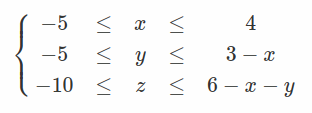
It is equivalent to:
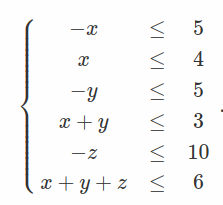
and this can be represented as `A*[x;y;z] <= b` where the matrix `A` is given by the coefficients of the variables at the LHS and the vector `b` is the one made of the bounds at the RHS.
Is it possible and how to get `A` and `b` from given symbolic inequalities `-5 <= x`, `x <= 4`, etc…?
---
### Author:  [@jd-foster](https://discourse.julialang.org/u/jd-foster)
#### Post date: [November 14, 2023, 10:25am UTC](https://discourse.julialang.org/t/matrix-vector-representation-of-a-system-of-linear-inequalities/106188/2 "2023-11-14T10:25:34Z")
There a ways to do this in JuMP, but they’re not documented: e.g.
> [@Get presolved model from Gurobi](https://discourse.julialang.org/t/get-presolved-model-from-gurobi/103827/6):
>
> There is an internal function to create a “standard form” version for inspecting the problem ## JuMP.jl/src/lp\_sensitivity2.jl: # Docstring: # Given a problem: # # r\_l \<= Ax \<= r\_u # c\_l \<= x \<= c\_u # # Return the standard form: # # [A -I] [x, y] = 0 # [c\_l, r\_l] \<= [x, y] \<= [c\_u, r\_u] # If you have an integral problem first do: undo\_relax = relax\_integrality(rmodel); then you can do s = JuMP.\_standard\_form\_matrix(rmodel) julia\> keys(s) (:columns, :lower, :upper, …
---
### Author:  [@\_stla](https://discourse.julialang.org/u/_stla)
#### Post date: [November 14, 2023, 11:32am UTC](https://discourse.julialang.org/t/matrix-vector-representation-of-a-system-of-linear-inequalities/106188/3 "2023-11-14T11:32:26Z")
Thanks! This does not directly gives what I want but it should not be difficult to get what I want from these outputs:
```julia
using JuMP
model = Model()
@variable(model, x)
@variable(model, y)
@variable(model, z)
@constraint(model, x >= 0)
@constraint(model, x <= 10)
@constraint(model, y >= 0)
@constraint(model, y <= 20-x)
@constraint(model, z >= -5)
@constraint(model, z <= 30-x-y)
undo_relax = relax_integrality(model)
s = JuMP._standard_form_matrix(model)
m, p = size(s.A)
A = s.A[:,1:(p-m)]
```
```julia
julia> A
6×3 SparseArrays.SparseMatrixCSC{Float64, Int64} with 9 stored entries:
1.0 ⋅ ⋅
⋅ 1.0 ⋅
⋅ ⋅ 1.0
1.0 ⋅ ⋅
1.0 1.0 ⋅
1.0 1.0 1.0
julia> s.lower
9-element Vector{Float64}:
-Inf
-Inf
-Inf
0.0
0.0
-5.0
-Inf
-Inf
-Inf
julia> s.upper
9-element Vector{Float64}:
Inf
Inf
Inf
Inf
Inf
Inf
10.0
20.0
30.0
```
---
### Author:  [@\_stla](https://discourse.julialang.org/u/_stla)
#### Post date: [November 14, 2023, 11:35am UTC](https://discourse.julialang.org/t/matrix-vector-representation-of-a-system-of-linear-inequalities/106188/4 "2023-11-14T11:35:19Z")
Hmm… I need the possibility to deal with `Rational` coefficients and bounds, and it seems that **JuMP** only returns some `Float64` stuff.
---
### Author:  [@\_stla](https://discourse.julialang.org/u/_stla)
#### Post date: [November 14, 2023, 8:33pm UTC](https://discourse.julialang.org/t/matrix-vector-representation-of-a-system-of-linear-inequalities/106188/5 "2023-11-14T20:33:12Z")
Thanks to some help I got on SO, I have this feature in Python, with SymPy.
```python
def __getAb0(inequalities, symbols, required_type):
# assumptions:
# 1. all inequalities are written with the same relational: < or <= or > or >=
# 2. For each inequality, LHS and RHS are linear in `symbols`
def get_ineq_with_correct_type(i, required_type):
if type(i) != required_type:
i = i.reversed
return i
# extract all inequalities, process them so they are all of the same type and
# terms containing `symbols` are on the LHS.
ineq = []
for i in inequalities:
if isinstance(i, And):
ineq.extend(
[get_ineq_with_correct_type(a, required_type) for a in i.args]
)
else:
ineq.append(get_ineq_with_correct_type(i, required_type))
# at this point, all inequalities should be of the same type.
# rewrite them as expressions: LHS - RHS
equations = [i.lhs - i.rhs for i in ineq]
return linear_eq_to_matrix(equations, symbols)
def getAb(inequalities, symbols):
"""
Get the matrix-vector representation of a set of linear inequalities.
Parameters
----------
inequalities : list
list of symbolic inequalities
symbols : list
list of symbols
Returns
-------
matrix
The matrix of the coefficients of the inequalities.
vector
The vector made of the bounds of the inequalities.
Examples
--------
>>> from pypolyhedralcubature.polyhedralcubature import getAb
>>> from sympy.abc import x, y, z
>>> # linear inequalities
>>> i1 = (x >= -5) & (x <= 4)
>>> i2 = (y >= -5) & (y <= 3 - x)
>>> i3 = (z >= -10) & (z <= 6 - x - y)
>>> # get matrix-vector representation of these inequalities
>>> A, b = getAb([i1, i2, i3], [x, y, z])
"""
A, b = __getAb0(inequalities, symbols, LessThan)
return np.array(A), np.array(b)[:, 0]
```
No way to do something like that in Julia? 🤔
---
### Author:  [@jd-foster](https://discourse.julialang.org/u/jd-foster)
#### Post date: [November 15, 2023, 5:12am UTC](https://discourse.julialang.org/t/matrix-vector-representation-of-a-system-of-linear-inequalities/106188/6 "2023-11-15T05:12:30Z")
[GitHub - JuliaPy/SymPy.jl: Julia interface to SymPy via PyCall](https://github.com/JuliaPy/SymPy.jl) ?
---
### Author:  [@odow](https://discourse.julialang.org/u/odow)
#### Post date: [November 15, 2023, 5:30am UTC](https://discourse.julialang.org/t/matrix-vector-representation-of-a-system-of-linear-inequalities/106188/7 "2023-11-15T05:30:43Z")
Perhaps it is time to make this a public function. People seem to keep wanting it
---
### Author:  [@\_stla](https://discourse.julialang.org/u/_stla)
#### Post date: [November 15, 2023, 9:10am UTC](https://discourse.julialang.org/t/matrix-vector-representation-of-a-system-of-linear-inequalities/106188/8 "2023-11-15T09:10:40Z")
Thanks. I’m aware of **SymPy.jl** but I have not been able to install it (on Windows). I don’t want to include a dependency with a potential difficulty in installing it.