# Julia install issue (foreign name)
**URL:** https://discourse.julialang.org/t/julia-install-issue-foreign-name/114522
**Category:** New to Julia
**Created:** [May 21, 2024, 5:31pm UTC](https://discourse.julialang.org/t/julia-install-issue-foreign-name/114522 "2024-05-21T17:31:42Z")
**Posts on this page:** 17
**Page:** 1
### Author:  [@Sihyun\_Kim](https://discourse.julialang.org/u/Sihyun_Kim)
#### Post date: [May 21, 2024, 5:31pm UTC](https://discourse.julialang.org/t/julia-install-issue-foreign-name/114522/1 "2024-05-21T17:31:42Z")
I installed Julia, and am trying to execute it by typing `julia` in Windows PowerShell. Then, the terminal shows
```julia
PS C:\Users\김시현> julia
ERROR: could not load library "C:\Users\김?�현\.julia\juliaup\julia-1.10.3+0.x64.w64.mingw32\lib\julia\sys.dll"
The specified module could not be found.
```
I think the error results from
> 김?�현
> I don’t understand where this weird character comes from. How should I fix this?
---
### Author:  [@Ahmed\_Salih](https://discourse.julialang.org/u/Ahmed_Salih)
#### Post date: [May 21, 2024, 5:35pm UTC](https://discourse.julialang.org/t/julia-install-issue-foreign-name/114522/2 "2024-05-21T17:35:46Z")
Perhaps it is your user name on your computer?
---
### Author:  [@ufechner7](https://discourse.julialang.org/u/ufechner7)
#### Post date: [May 21, 2024, 5:44pm UTC](https://discourse.julialang.org/t/julia-install-issue-foreign-name/114522/3 "2024-05-21T17:44:27Z")
I think that indeed Julia will not work if you install it in a home folder with non-ascii letters or with spaces…
What you can do if you use bash:
```julia
export JULIA_DEPOT_PATH="/.julia"
```
if the folder /.julia exists and can be written as normal user…
You might need a different command for powershell…
The key message: Create and environment variable with the name JULIA\_DEPOT\_PATH and set it to a path that exists, is writable and contains only ASCII characters…
Then everything should work fine…
---
### Author:  [@nhz2](https://discourse.julialang.org/u/nhz2)
#### Post date: [May 21, 2024, 8:20pm UTC](https://discourse.julialang.org/t/julia-install-issue-foreign-name/114522/4 "2024-05-21T20:20:15Z")
This looks like a bug in either julia or juliaup on Windows. Do the 64 bit “portable” or “installer” manual downloads from [Download Julia](https://julialang.org/downloads/#official_binaries_for_manual_download) work?
---
### Author:  [@mkitti](https://discourse.julialang.org/u/mkitti)
#### Post date: [May 21, 2024, 8:32pm UTC](https://discourse.julialang.org/t/julia-install-issue-foreign-name/114522/5 "2024-05-21T20:32:51Z")
You may also want to change the environment variable `JULIAUP_DEPOT_PATH`:
> [@PSA: Breaking change how juliaup interacts with JULIA\_DEPOT\_PATH](https://discourse.julialang.org/t/psa-breaking-change-how-juliaup-interacts-with-julia-depot-path/106497):
>
> This is a short note that I am about to push a breaking update for Juliaup to everyone that changes how Juliaup interacts with JULIA\_DEPOT\_PATH. This is a pretty esoteric topic, so for most users of Juliaup, it is probably entirely safe to ignore this slight_smile The short version is that from now on one should use the JULIAUP\_DEPOT\_PATH environmental variable to configure into which depot Juliaup will put its configuration. Previously one could change that via the JULIA\_DEPOT\_PATH environme…
---
### Author:  [@giordano](https://discourse.julialang.org/u/giordano)
#### Post date: [May 21, 2024, 10:04pm UTC](https://discourse.julialang.org/t/julia-install-issue-foreign-name/114522/6 "2024-05-21T22:04:36Z")
Indeed, we’ve seen many reports of users having troubles to load libraries from paths which include non-ASCII characters: [Failed process 'gdk-pixbuf-query-loaders.exe' during load on Windows · Issue #461 · JuliaGraphics/Gtk.jl · GitHub](https://github.com/JuliaGraphics/Gtk.jl/issues/461), [(julia.exe:7396): Gtk-WARNING \*\*: 21:07:31.246: Could not load a pixbuf from icon theme. · Issue #497 · JuliaGraphics/Gtk.jl · GitHub](https://github.com/JuliaGraphics/Gtk.jl/issues/497), [julia.exe starting error with Korean path-name. · Issue #33486 · JuliaLang/julia · GitHub](https://github.com/JuliaLang/julia/issues/33486). This may have been fixed by [update libuv to v2-1.48.0 by vtjnash · Pull Request #49937 · JuliaLang/julia · GitHub](https://github.com/JuliaLang/julia/pull/49937), which is in Julia v1.11, although I’m still not 100% libuv is related to this specific issue, I guess some Windows users will have to confirm that.
---
### Author:  [@woclass](https://discourse.julialang.org/u/woclass)
#### Post date: [May 22, 2024, 12:23am UTC](https://discourse.julialang.org/t/julia-install-issue-foreign-name/114522/7 "2024-05-22T00:23:49Z")
An update to libuv (pr#49937) is included in v1.11-beta.
I tested it in a clean windows sandbox:
Seems works fine.

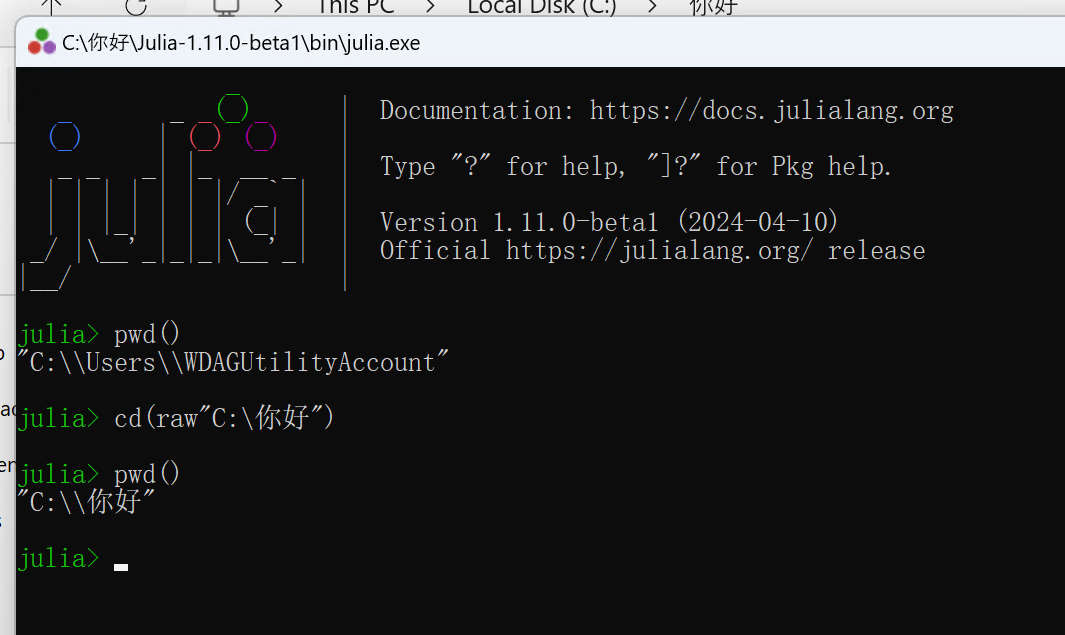
> “你好” means “hello” in chinese.
---
### Author:  [@giordano](https://discourse.julialang.org/u/giordano)
#### Post date: [May 22, 2024, 12:32am UTC](https://discourse.julialang.org/t/julia-install-issue-foreign-name/114522/8 "2024-05-22T00:32:51Z")
Did you experience issues in the same configuration with Julia \< 1.11 though?
---
### Author:  [@StefanKarpinski](https://discourse.julialang.org/u/StefanKarpinski)
#### Post date: [May 22, 2024, 1:18am UTC](https://discourse.julialang.org/t/julia-install-issue-foreign-name/114522/9 "2024-05-22T01:18:42Z")
The issue was that Windows paths use invalid UTF-16 to encode Korean names. Libuv uses UTF-8. Until recently libuv insisted on strict UTF-8 which means that when Windows gives it invalid UTF-16 (unpaired surrogates), it simply cannot handle it. There is, however, a thing called WTF-8, which is just UTF-8 allowing surrogate code points (they’re fine from UTF-8’s perspective, just technically disallowed), which allows handling arbitrary invalid UTF-16. @jameson and I finally got libuv to use WTF-8, so this is expected to be fixed now.
---
### Author:  [@woclass](https://discourse.julialang.org/u/woclass)
#### Post date: [May 22, 2024, 2:57am UTC](https://discourse.julialang.org/t/julia-install-issue-foreign-name/114522/10 "2024-05-22T02:57:49Z")
> [@giordano](#):
>
> Did you experience issues in the same configuration with Julia \< 1.11 though?
Bad news: after more careful testing, this issue still exists on v1.11-beta1.
The problem in my last test: my main system language is set to Chinese and the code page is 936, in the sandbox the language is set to English and the code page is also 936.
cp936 seems to maintain compatibility with UTF8, so no invalid UTF16 is generated.
Set the global language of the sandbox to Korean.
The default code page changes to cp 949.
Create a new test folder “테스트” again
Both v1.10.3 and v1.11.0-beta1 cannot load sys.dll
When the path contains only ascii characters, everything works fine.

* * *
The problem seems to be in the call to MultiByteToWideChar, where it is assumed that the input string is encoded in UTF8, while the actual incoming encoding is affected by the system language and code page settings.
>
---
### Author:  [@nhz2](https://discourse.julialang.org/u/nhz2)
#### Post date: [May 22, 2024, 3:00am UTC](https://discourse.julialang.org/t/julia-install-issue-foreign-name/114522/11 "2024-05-22T03:00:42Z")
I tested this on Julia 1.11 and got the same error. I was able to fix the issue and run Julia on a test user after enabling “Beta: Use Unicode UTF-8 for worldwide language support” in Time & Language → Language → “Administrative Language Settings”, and rebooting.
---
### Author:  [@giordano](https://discourse.julialang.org/u/giordano)
#### Post date: [May 22, 2024, 8:15am UTC](https://discourse.julialang.org/t/julia-install-issue-foreign-name/114522/12 "2024-05-22T08:15:19Z")
That makes more sense to me, thanks. What’s failing is basically our implementation of dlopen, which explains the issues I linked above (they’re about loading libraries), and has nothing to do with libuv, which explains why the mentioned PR didn’t solve this specific issue (as I expected).
---
### Author:  [@StefanKarpinski](https://discourse.julialang.org/u/StefanKarpinski)
#### Post date: [May 22, 2024, 2:46pm UTC](https://discourse.julialang.org/t/julia-install-issue-foreign-name/114522/13 "2024-05-22T14:46:52Z")
Are you able to open an issue describing this or make PR to address this? Would be great if this just worked now that libuv supports it. Of
Course, I also thin like that everyone should just use UTF-8 for stuff like this, so I don’t see the “workaround” as a workaround really—it’s the way things should be done.
---
### Author:  [@Redmusk888](https://discourse.julialang.org/u/Redmusk888)
#### Post date: [December 10, 2024, 11:04am UTC](https://discourse.julialang.org/t/julia-install-issue-foreign-name/114522/14 "2024-12-10T11:04:33Z")
I recommend just REINSTALL your pc and change your user to english name for anyone who has same problem, it would be fast that you search solution on the internet and figure out it yourself.
---
### Author:  [@Palli](https://discourse.julialang.org/u/Palli)
#### Post date: [December 10, 2024, 2:10pm UTC](https://discourse.julialang.org/t/julia-install-issue-foreign-name/114522/15 "2024-12-10T14:10:31Z")
>
>
> Hello, everyone.
> My setting is Julia 1.2 on Win10 with Korean locale.
>
> After …installing julia, everytime I try to start julia.exe,
> it is raising a error "sys.dll not found".
>
> It seems that Julia.exe does not recognize the file-path including Korean characters(in my case, it is username). If the username consists with only ascii characters, there is no problem.
> In Julia REPL itself, everything is fine with Korean file-path.
>
> I hope this report contributes to the Julia project.
> Thank you!
> it’s not working well which has installed on the destination path that contains Korean characters (it has not encoded as utf-8 by the historical reasons) in windows system.
>
> installing the other programming languages (like Python, R, Matlab) got the same problem.
I believe this is no longer an “upstream” issue (in libuv), but if anyone wants to fix this open issue in Julia, then make sure there’s no security issue, or well fix it also, see below.
> [@Redmusk888](#):
>
> I recommend just REINSTALL your pc and change your user to English name
That seems like overkill, but if you do then do choose a good or best code page (either UTF-8 or) GB\_18030 for Chinese and Koren/Hangul, 2-bytes per letter, twice as efficient as UTF-8 or anything other, also supporting all languages. Just changing to English or well ASCII in the path should be enough (and all filenames used by Julia), without reinstall, should be enough to start Julia and get anything to work. I was assuming the Korean EUC-KR encoding used, and many encodings including e.g. cp936, have an ASCII subset (if using only that, I believe you’re safe). If you DO reinstall, and choose appropriate encoding, e.g. UTF-8, then you should get away with any path/filename, not just English/ASCII, though likely not spaces in many contexts… (good software should though also handle that).
You may want to avoid e.g. cp936, for security reasons, at least for PHP. I would like to know if the security issue applies to Julia too, for sure, or at least potentially, and if also for GB\_18030 which is seemingly a superset encoding of it.
If you do not want to rename, e.g. your user folder to ASCII, then maybe keeping it and making an ASCII symlink to it for Julia would help:
> **[The Complete Guide to Creating Symbolic Links (aka Symlinks) on Windows](https://www.howtogeek.com/16226/complete-guide-to-symbolic-links-symlinks-on-windows-or-linux/)**
>
> Symbolic links are really underutilized in Windows.
There are only three Unicode encodings, thereof IMHO 1 or 2 are good, UTF-8, and well this (not UTF-16) is the other one:
> **[GB 18030](https://en.wikipedia.org/wiki/GB_18030)**
>
> GB 18030 is a Chinese government standard, described as Information Technology — Chinese coded character set and defines the required language and character support necessary for software in China. GB18030 is the registered Internet name for the official character set of the People's Republic of China (PRC) superseding GB2312. As a Unicode Transformation Format\[a\] (i.e. an encoding of all Unicode code points), GB18030 supports both simplified and traditional Chinese characters. It is also comp Th...
So use UTF-8 (aka in Windows `codepage 65001` or in source code **CP\_UTF8** ).
Or use GB\_18030 which is also good for the web. UTF-16 is no good for the web since it’s not ASCII compatible. Other sort-of important encodings, none of Unicode UTFs, and UTF-8 always way more popular on the web, are Windows-1521 for Russian/Cyrillic, [Unified Hangul Code](https://en.wikipedia.org/wiki/Unified_Hangul_Code)/CP949/[EUC-KR](https://en.wikipedia.org/wiki/EUC-KR), EUC-JP and the even lesser used Shift\_JIS that seems to be crashing in use (but it and UTF-8 are though supported by QR codes).
> [@woclass](#):
>
> The problem in my last test: my main system language is set to Chinese and the code page is 936, in the sandbox the language is set to English and the code page is also 936.
>
> cp936 seems to maintain compatibility with UTF8, so no invalid UTF16 is generated.
Are you using (most likely): [Code page 936 (Microsoft Windows) - Wikipedia](https://en.wikipedia.org/wiki/Code_page_936_(Microsoft_Windows))
> **Windows code page 936** (abbreviated **MS936** , **Windows-936** or ([ambiguously](https://en.wikipedia.org/wiki/Code_page_936_(IBM))) **CP936** )
or (likely not, and maybe the info below also confuses the two): [Code page 936 (IBM) - Wikipedia](https://en.wikipedia.org/wiki/Code_page_936_(IBM))
> **[Nasty bug with very simple exploit hits PHP just in time for the weekend](https://arstechnica.com/security/2024/06/php-vulnerability-allows-attackers-to-run-malicious-code-on-windows-servers/)**
>
> With PoC code available and active Internet scans, speed is of the essence.
> Exploit PoC is public.
>
> Details: [Security Alert: CVE-2024-4577 - PHP CGI Argument Injection Vulnerability | DEVCORE](https://devco.re/blog/2024/06/06/security-alert-cve-2024-4577-php-cgi-argument-injection-vulnerability-en/)
>
> Note currently verified as exploitable on installation with the following locales:
>
> - Traditional Chinese (Code Page 950)
> - Simplified Chinese (Code Page 936)
> - Japanese (Code Page 932)
>
> ### When “Best Fit” isn’t
>
> “A nasty bug with a very simple exploit—perfect for a Friday afternoon,” researchers with security firm WatchTowr [wrote](https://labs.watchtowr.com/no-way-php-strikes-again-cve-2024-4577/).
>
> CVE-2024-4577, as the vulnerability is tracked, stems from errors in the way PHP converts unicode characters into ASCII. A [feature](https://learn.microsoft.com/en-us/openspecs/windows_protocols/ms-ucoderef/d1980631-6401-428e-a49d-d71394be7da8) built into Windows known as Best Fit allows attackers to use a technique known as [argument injection](https://cheatsheetseries.owasp.org/cheatsheets/OS_Command_Injection_Defense_Cheat_Sheet.html#argument-injection) to pass user-supplied input into commands executed by an application, in this case, PHP. Exploits allow attackers to bypass [CVE-2012-1823](https://arstechnica.com/information-technology/2014/03/php-bug-allowing-site-hijacking-still-menaces-internet-22-months-on/), a critical code execution vulnerability patched in PHP in 2012.
>
> IMPACT:
>
> - This vulnerability affects the following PHP versions:
> – 8.1 before 8.1.29
> – 8.2 before 8.2.20
> – 8.3 before 8.3.8
> - This vulnerability is applicable when:
> – Using Apache and PHP-CGI on Windows with character sets (charsets):
> — 936: simplified Chinese charset, more info at [Code page 936 (IBM) - Wikipedia](https://en.wikipedia.org/wiki/Code_page_936_(IBM))
> — 950: traditional Chinese charset, more info at [Code page 950 - Wikipedia](https://en.wikipedia.org/wiki/Code_page_950)
> — 932: Japanese charset, more info at [Code page 932 (Microsoft Windows) - Wikipedia](https://en.wikipedia.org/wiki/Code_page_932_(Microsoft_Windows))
> – Or when using the XAMPP development environment with default configurations on Windows with the same charsets.
> — More info on XAMPP at [https://www.apachefriends.org/](https://www.apachefriends.org/)
>
> EXPLOITATION MECHANISM:
>
> - The Windows feature “Best Fit” converts 0xAD to 0x2D.
> - Malicious code can be passed through “php://input” and executed using the “auto\_prepend\_file” option to call “include\_path.”
> - We have also seen the “auto\_append\_file” option.
>
> EXPLOITATION IN THE WILD:
>
> - Since June 6th, our telemetry has revealed numerous exploitation attempts against this vulnerability.
>
> SOLUTION:
>
> - Upgrade PHP on any vulnerable hosts to the latest version.
> - To mitigate this vulnerability, we recommend our customers install the latest content updates for Palo Alto Networks Advanced Threat Protection (ATP).
---
### Author:  [@Palli](https://discourse.julialang.org/u/Palli)
#### Post date: [December 10, 2024, 5:29pm UTC](https://discourse.julialang.org/t/julia-install-issue-foreign-name/114522/16 "2024-12-10T17:29:39Z")
@essenciary does Genie.jl have anything like `auto_prepend_file` or `auto_append_file`? Do you think this is very PHP specific, not an issue for your package or any Julia-related or other languages?
About the 2024 security issue for PHP (now patched) for at least cp936, that may or may not apply to Julia too (probably not, seems to rely on obscure PHP feature: [Using "auto\_prepend\_file" into ".user.ini" file in PHP - Stack Overflow](https://stackoverflow.com/questions/24778706/using-auto-prepend-file-into-user-ini-file-in-php))
> [@Palli](#):
>
> EXPLOITATION MECHANISM:
>
> - The Windows feature “Best Fit” converts 0xAD to 0x2D.
> - Malicious code can be passed through “php://input” and executed using the “auto\_prepend\_file” option to call “include\_path.”
> - We have also seen the “auto\_append\_file” option.
I.e. converts (0x00 prepended to) soft-hyphen, aka **syllable hyphen** **optional hyphen** (a usually invisible non-char), to (0x00 then) visible hyphen-minus (I can see it being insecure), as seen here:
[https://www.unicode.org/Public/MAPPINGS/VENDORS/MICSFT/WindowsBestFit/bestfit936.txt](https://www.unicode.org/Public/MAPPINGS/VENDORS/MICSFT/WindowsBestFit/bestfit936.txt)
> 0x00ad 0x002d ;-
note also there:
> WCTABLE 24482
> […]
> 0xad 0x4f03 ;��
and
> 0x2d 0x002d ;-
Info on this here: [Index of /Public/MAPPINGS/VENDORS/MICSFT/WindowsBestFit](https://www.unicode.org/Public/MAPPINGS/VENDORS/MICSFT/WindowsBestFit/)
> 0x0063 0x63 ;Latin Small Letter C
> …
> 0x221e 0x38 ;Infinity \<\< Best Fit Mapping
> …
> 0xff41 0x61 ;Fullwidth Latin Small Letter A \<\< Best Fit Mapping
It seems to me that “[fullwidth forms](https://en.wikipedia.org/wiki/Halfwidth_and_fullwidth_forms) for legacy [CJK](https://en.wikipedia.org/wiki/CJK_characters) font compatibility” like
```julia
julia> Char(0xff41)
'a': Unicode U+FF41 (category Ll: Letter, lowercase)
```
will be converted to:
```julia
julia> Char(0x61)
'a': ASCII/Unicode U+0061 (category Ll: Letter, lowercase)
```
It seems intentional, but maybe not always desired. Though I think it’s probably not a security issue. More like you can’t have different files with only this change in the filename or path. Just as Windows file system is case insensitive.
---
### Author:  [@nhz2](https://discourse.julialang.org/u/nhz2)
#### Post date: [October 20, 2025, 2:31pm UTC](https://discourse.julialang.org/t/julia-install-issue-foreign-name/114522/17 "2025-10-20T14:31:28Z")
I have a PR that fixes this issue from my tests on Windows 11 with the system locale set to Korean [Use libuv in absrealpath to fix Korean path names on Windows by nhz2 · Pull Request #59910 · JuliaLang/julia · GitHub](https://github.com/JuliaLang/julia/pull/59910)