# Is There Package or Method to Calculate Certain Area in Julia (symbolically with SymPy)?
**URL:** https://discourse.julialang.org/t/is-there-package-or-method-to-calculate-certain-area-in-julia-symbolically-with-sympy/99751
**Category:** General Usage
**Tags:** question
**Created:** [June 2, 2023, 3:57am UTC](https://discourse.julialang.org/t/is-there-package-or-method-to-calculate-certain-area-in-julia-symbolically-with-sympy/99751 "2023-06-02T03:57:57Z")
**Posts on this page:** 14
**Page:** 1
### Author:  [@Freya\_the\_Goddess](https://discourse.julialang.org/u/Freya_the_Goddess)
#### Post date: [June 2, 2023, 3:57am UTC](https://discourse.julialang.org/t/is-there-package-or-method-to-calculate-certain-area-in-julia-symbolically-with-sympy/99751/1 "2023-06-02T03:57:57Z")
Hi all,
there are two circles, one is bigger than the other, and overlapping a bit, I want to know could Julia help to calculate the bigger circle shaded area? Maybe this is geometry problem. But it is on Calculus book.
This is the solution:

I am using Latex to draw it, I can’t hardly plot it with Julia, too difficult:
```julia
\documentclass[12pt]{article}
\usepackage{tikz}
\usetikzlibrary{decorations.pathreplacing}
\usetikzlibrary {calc}
\newcommand{\MarkRightAngle}[4][.3cm]% #1=size (optional), #2-#4 three points: \angle #2#3#4
{\coordinate (tempa) at ($(#3)!#1!(#2)$);
\coordinate (tempb) at ($(#3)!#1!(#4)$);
\coordinate (tempc) at ($(tempa)!0.5!(tempb)$);%midpoint
\draw (tempa) -- ($(#3)!2!(tempc)$) -- (tempb);
}
\begin{document}
\begin{tikzpicture}[scale=1,>=latex,x=1cm,y=0.8cm]
\draw[fill=blue!7] (0,0) ellipse (4 and 4);% a circle
\draw[fill=blue!7] (-4,0) arc (180:360:4 and 4);% left half of the circle starting at (-4,0) from 180 to 360
\draw[fill=white!7] (0,-3) ellipse (3 and 3);% a circle
\draw (0,0.2) node {$A$};
\draw (0,-3.6) node {$C$};
\draw (-3.5,-3.1) node {$D$};
\draw (3.5,-3.1) node {$B$};
\draw (1.5,-3.2) node {$a$};
% Create right angle
\coordinate (A) at (0,0);
\coordinate (E) at (1.6,-1.4);
\coordinate (C) at (0,-3);
\MarkRightAngle{A}{E}{C}
\draw[dashed] (0,-3) -- (1.6,-1.4);
\draw[-,thick] (0,0) -- (-3,-2.7) node[left, midway] {\footnotesize $b$};
\draw[-,thick] (0,0) -- (3,-2.7) node[right, midway] {\footnotesize $E$};
\draw[-,thick] (0,0) -- (0,-3) node[left, midway] {\footnotesize $a$};
\draw[-,thick] (-3,-2.7) -- (0,-3);
\draw[-,thick] (3,-2.7) -- (0,-3);
\end{tikzpicture}
\end{document}
```
The question is:
**If I plot it with Julia, two circles with certain radius and center, can I compute the certain area that is not intersected with other geometry object like the solution above?**
---
### Author:  [@DanielVandH](https://discourse.julialang.org/u/DanielVandH)
#### Post date: [June 2, 2023, 4:13am UTC](https://discourse.julialang.org/t/is-there-package-or-method-to-calculate-certain-area-in-julia-symbolically-with-sympy/99751/2 "2023-06-02T04:13:13Z")
Never used it, but you could take a look at [GitHub - mancellin/PolygonArea.jl: A claimless Julia library to compute the area of unions and intersections of polygons](https://github.com/mancellin/PolygonArea.jl). I don’t imagine you’d be able to do much here symbolically, though.
---
### Author:  [@Freya\_the\_Goddess](https://discourse.julialang.org/u/Freya_the_Goddess)
#### Post date: [June 2, 2023, 4:20am UTC](https://discourse.julialang.org/t/is-there-package-or-method-to-calculate-certain-area-in-julia-symbolically-with-sympy/99751/3 "2023-06-02T04:20:02Z")
Alright thanks for this, I will check it out
---
### Author:  [@Freya\_the\_Goddess](https://discourse.julialang.org/u/Freya_the_Goddess)
#### Post date: [June 2, 2023, 7:12am UTC](https://discourse.julialang.org/t/is-there-package-or-method-to-calculate-certain-area-in-julia-symbolically-with-sympy/99751/4 "2023-06-02T07:12:47Z")
The package can draw intersection and union, but not setminus…
```julia
using PolygonArea, Plots
r = rectangle((0.0, 0.0), (1.0, 1.0))
c1 = circle((0.9, 1.5), 1.5, 100) # Actually, a regular 100-gon
c2 = circle((0.9, 3), 2, 100) # Actually, a regular 100-gon
cinter = c1 ∩ c2
#a = area(c1 ∩ c2)
#println("area = ", a)
plot(c2)
plot!(c1, color=:green)
#plot(c1 ∖ c2) does not work
```
---
### Author:  [@rocco\_sprmnt21](https://discourse.julialang.org/u/rocco_sprmnt21)
#### Post date: [June 3, 2023, 3:28pm UTC](https://discourse.julialang.org/t/is-there-package-or-method-to-calculate-certain-area-in-julia-symbolically-with-sympy/99751/5 "2023-06-03T15:28:06Z")
To draw the figure you could use this package, although perhaps it needs to be tuned better for a better definition.
To have a symbolic solution, either do it by hand or try with GPT v5
```julia
using ImplicitEquations, Plots
f(x,y) = (x-0.9)^2+(y-1.5)^2-1.5^2
g(x,y) = (x-0.9)^2+(y-3.)^2-2.0^2
plot((g ≦ 0) & (f ≫ 0) , fc=:black, widen=false, aspect_ratio=:equal)
```
this is the figure obtained. Maybe someone knows how to make it better.

---
### Author:  [@rocco\_sprmnt21](https://discourse.julialang.org/u/rocco_sprmnt21)
#### Post date: [June 3, 2023, 9:32pm UTC](https://discourse.julialang.org/t/is-there-package-or-method-to-calculate-certain-area-in-julia-symbolically-with-sympy/99751/6 "2023-06-03T21:32:56Z")
i tried kinda PLAYING with sympy.
```julia
using SymPy
@syms x y
julia> f(x,y) = (x-9//10)^2+(y-3//2)^2-(3//2)^2
f (generic function with 2 methods)
julia> g(x,y) = (x-9//10)^2+(y-3)^2-2^2
g (generic function with 1 method)
julia> ((x1,y1),(x2,y2))=solve([f(x,y) , g(x,y)], x, y)
2-element Vector{Tuple{Sym, Sym}}:
(9/10 - 2*sqrt(5)/3, 5/3)
(9/10 + 2*sqrt(5)/3, 5/3)
julia> ft(x,y) = (x)^2+(y+5//3-3//2)^2-(3//2)^2
ft (generic function with 1 method)
julia> gt(x,y) = (x)^2+(y+5//3-3)^2-2^2
gt (generic function with 1 method)
julia> ((x1,y1),(x2,y2))=solve([ft(x,y) , gt(x,y)], x, y)
2-element Vector{Tuple{Sym, Sym}}:
(-2*sqrt(5)/3, 0)
(2*sqrt(5)/3, 0)
julia> nscf(x),pscf(x)=solve(ft(x,y),y)
2-element Vector{Sym}:
-sqrt(9 - 4*x^2)/2 - 1/6
sqrt(9 - 4*x^2)/2 - 1/6
julia> S1=integrate(pscf(x), x1,x2)
⎛4⋅√5⎞
9⋅asin⎜────⎟
√5 ⎝ 9 ⎠
- ── + ────────────
9 4
julia> nscg(x),pscg(x)=solve(gt(x,y),y)
2-element Vector{Sym}:
4/3 - sqrt(4 - x^2)
sqrt(4 - x^2) + 4/3
julia> S2=integrate(nscg(x), x1,x2)
⎛√5⎞ 8⋅√5
- 4⋅asin⎜──⎟ + ────
⎝3 ⎠ 9
julia> Sym(π)*4- (S1-S2)
⎛4⋅√5⎞
9⋅asin⎜────⎟
⎛√5⎞ ⎝ 9 ⎠
- 4⋅asin⎜──⎟ - ──────────── + √5 + 4⋅π
⎝3 ⎠ 4
```
---
### Author:  [@Freya\_the\_Goddess](https://discourse.julialang.org/u/Freya_the_Goddess)
#### Post date: [June 6, 2023, 8:32am UTC](https://discourse.julialang.org/t/is-there-package-or-method-to-calculate-certain-area-in-julia-symbolically-with-sympy/99751/7 "2023-06-06T08:32:29Z")
Very beautiful @rocco_sprmnt21 . This is why I find enjoyment learning Mathematics and sharing here in this discourse. The experts help beginner like me a lot.
---
### Author:  [@rocco\_sprmnt21](https://discourse.julialang.org/u/rocco_sprmnt21)
#### Post date: [June 6, 2023, 2:56pm UTC](https://discourse.julialang.org/t/is-there-package-or-method-to-calculate-certain-area-in-julia-symbolically-with-sympy/99751/8 "2023-06-06T14:56:44Z")
I too (not being a real expert, like many others in this forum) find it interesting to follow the discussions and, when possible, participate.
I would like to add an observation. Maybe a bit fussy, but that might be why symbolic solving with SymPy functions doesn’t come “easy”.
The practical observation is that the result shown in the book is valid only for a/b \>=1/2.
For a/b\<1/2 the gray surface is always S(a/b=1/2)
An additional observation is that it would be nice to be able to add assumptions (constraints?) in order to “oblige” the SymPy functions to give only the “physically/geometrically” expected solutions.
---
### Author:  [@rocco\_sprmnt21](https://discourse.julialang.org/u/rocco_sprmnt21)
#### Post date: [June 6, 2023, 5:36pm UTC](https://discourse.julialang.org/t/is-there-package-or-method-to-calculate-certain-area-in-julia-symbolically-with-sympy/99751/9 "2023-06-06T17:36:10Z")
Without losing generality, the figures can be translated into a reference of Cartesian axes, so as to have the center of the circle of radius b at the origin O of the axes.
Similarly, to make life easier for SymPy, you can scale everything by a factor b, so that b=\>1 to a=\>a/b.
So the transformations that serve to symbolically solve the problem are the following.
```julia
julia> using SymPy
julia> @syms x
(x,)
julia> @vars a y positive=true
(a, y)
julia> ft(x,y) = (x-a)^2+(y)^2-a^2
ft (generic function with 1 method)
julia> gt(x,y) = (x)^2+(y)^2-1
gt (generic function with 1 method)
julia> (x1,y1)=solve([ft(x,y) , gt(x,y)], x, y)[1]
(1/(2*a), sqrt(2*a - 1)*sqrt(2*a + 1)/(2*a))
julia> nscf(x),pscf(x)=solve(ft(x,y),y)
2-element Vector{Sym}:
-sqrt(x*(2*a - x))
sqrt(x*(2*a - x))
julia> S1=integrate(expand(pscf(x)), (x, 0,x1)) # using pscf(x) whitout expand give a messy formula
⎛ 1 ⎞
⎜-a + ───⎟
2 ⎜ 2⋅a⎟
a ⋅asin⎜────────⎟ 2 __________
⎝ a ⎠ π⋅a ╱ 1 ⎛ a 1 ⎞
───────────────── + ──── + ╱ 1 - ──── ⋅⎜- ─ + ───⎟
2 4 ╱ 2 ⎝ 2 4⋅a⎠
╲╱ 4⋅a
julia> nscg(x),pscg(x)=solve(gt(x,y),y)
2-element Vector{Sym}:
-sqrt(1 - x^2)
sqrt(1 - x^2)
julia> S2=integrate(pscg(x), (x, x1,1))
__________
╱ 1
⎛ 1 ⎞ ╱ 1 - ────
asin⎜───⎟ ╱ 2
⎝2⋅a⎠ π ╲╱ 4⋅a
- ───────── + ─ - ───────────────
2 4 4⋅a
```
I enclose the analogous operations done by hand.
With a little patience it can be verified that the two results are equivalent

---
### Author:  [@Freya\_the\_Goddess](https://discourse.julialang.org/u/Freya_the_Goddess)
#### Post date: [June 7, 2023, 9:43am UTC](https://discourse.julialang.org/t/is-there-package-or-method-to-calculate-certain-area-in-julia-symbolically-with-sympy/99751/10 "2023-06-07T09:43:34Z")
That is a very nice observation knowing the result only valid for a/b \>= 1/2.
We will always need assumptions and constraints then, because if not limited then the solution is boundless.
---
### Author:  [@mancellin](https://discourse.julialang.org/u/mancellin)
#### Post date: [June 7, 2023, 11:55am UTC](https://discourse.julialang.org/t/is-there-package-or-method-to-calculate-certain-area-in-julia-symbolically-with-sympy/99751/11 "2023-06-07T11:55:34Z")
Hi, I’m the author of PolygonArea.jl. Thank you for considering using it!
Actually set difference has been implemented but with the backslash `\` operator as I wasn’t aware of `\setminus` (sorry for the lack of documentation).
Anyway, the implementation of PolygonArea is dreadfully inefficient for concave shapes with many edges, such as your `c1 \ c2`.
But if you only need the area, maybe you could do instead
```julia
area(c1) - area(c1 ∩ c2)
```
that should work fine.
---
### Author:  [@Freya\_the\_Goddess](https://discourse.julialang.org/u/Freya_the_Goddess)
#### Post date: [June 8, 2023, 5:26am UTC](https://discourse.julialang.org/t/is-there-package-or-method-to-calculate-certain-area-in-julia-symbolically-with-sympy/99751/12 "2023-06-08T05:26:48Z")
Hi @mancellin ,
thanks for the package, it is really amazing and useful for students like me.
I want to straighten out that the mistake is on the character, I type this:
```julia
plot(c1 ∖ c2)
```
but the backlash is from copy paste from Julia Documentation, I should have type backlash directly from keyboard, notice this when I see it from Mousepad / Notepad of Linux:
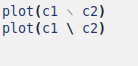
The above won’t work. but below will work.
My mistake.
This code works:
```julia
# https://discourse.julialang.org/t/is-there-package-or-method-to-calculate-certain-area-in-julia-symbolically-with-sympy/99751/4
using PolygonArea, Plots
r = rectangle((0.0, 0.0), (1.0, 1.0))
c1 = circle((0.9, 1.5), 1.5, 100) # Actually, a regular 100-gon
c2 = circle((0.9, 3), 2, 100) # Actually, a regular 100-gon
cinter = c1 ∩ c2
#a = area(c1 ∩ c2)
#println("area = ", a)
#plot(c2)
#plot!(c1, color=:green)
plot(c2 \ c1)
```
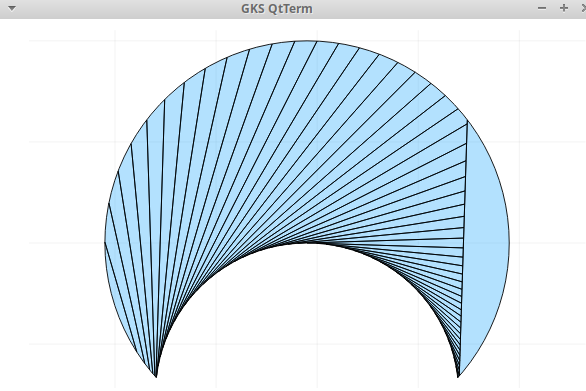
I love trying Julia and its packages, it is amazing for people around the world to learn Mathematics with Computer Science at one time.
---
### Author:  [@Freya\_the\_Goddess](https://discourse.julialang.org/u/Freya_the_Goddess)
#### Post date: [June 9, 2023, 3:39am UTC](https://discourse.julialang.org/t/is-there-package-or-method-to-calculate-certain-area-in-julia-symbolically-with-sympy/99751/13 "2023-06-09T03:39:39Z")
This is something that I want to ask:

If we can get the \theta and \phi from angle DCB and angle DAB in terms of \arccos and \arcsin from the solution above, **Why the solution suggest that \theta and \phi are in radians?**
Btw,
b = radius of big circle
a = radius of small circle
The small circle perimeter (North perimeter) hit the center of the big circle.
---
### Author:  [@rocco\_sprmnt21](https://discourse.julialang.org/u/rocco_sprmnt21)
#### Post date: [June 9, 2023, 6:43am UTC](https://discourse.julialang.org/t/is-there-package-or-method-to-calculate-certain-area-in-julia-symbolically-with-sympy/99751/14 "2023-06-09T06:43:02Z")
I don’t know how pertinent this is to Julia and I’m not sure of the author’s motivation in preferring the use of radians to degrees.
I would think that a good reason could be the greater simplicity of the formulas, in the case of the use of radians.
For example a famous limit of analysis `[lim(sin(x)/x) when x->0] = 1` only if x is measured in radians.