# How to use partial derivate in my code?
**URL:** https://discourse.julialang.org/t/how-to-use-partial-derivate-in-my-code/134176
**Category:** General Usage
**Tags:** question
**Created:** [November 28, 2025, 2:10am UTC](https://discourse.julialang.org/t/how-to-use-partial-derivate-in-my-code/134176 "2025-11-28T02:10:45Z")
**Posts on this page:** 4
**Page:** 1
### Author:  [@Mr.Fool](https://discourse.julialang.org/u/Mr.Fool)
#### Post date: [November 28, 2025, 2:10am UTC](https://discourse.julialang.org/t/how-to-use-partial-derivate-in-my-code/134176/1 "2025-11-28T02:10:45Z")

I want to use the partial marked red in the figure to write my own code. The code I want to write is like figure below.
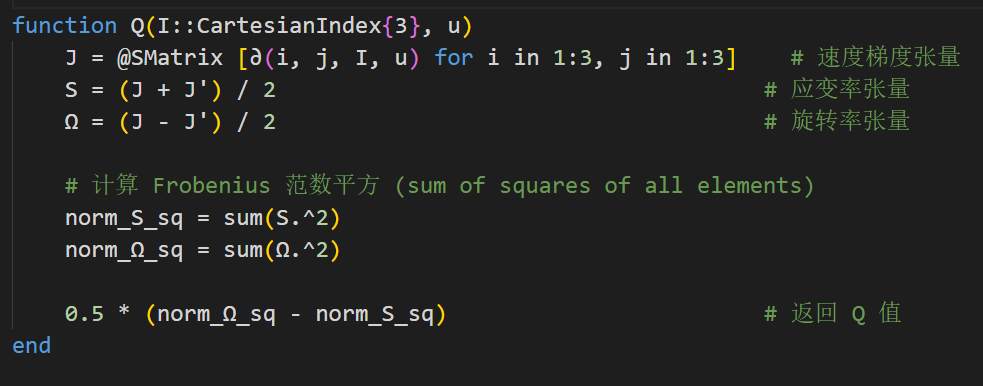
But an error occurred.

How can I achieve my code? Thank you for your answer.
---
### Author:  [@ufechner7](https://discourse.julialang.org/u/ufechner7)
#### Post date: [November 28, 2025, 2:41am UTC](https://discourse.julialang.org/t/how-to-use-partial-derivate-in-my-code/134176/2 "2025-11-28T02:41:20Z")
Welcome to the Julia forum!
Two remarks:
1. Please do share code as text enclosed in triple backticks like ``` and not as screenshots.
2. Please share a complete example, including the using statements and example input data.
This makes it much easier for others to reproduce your problem.
Also helpful: the output of:
```julia-auto
versioninfo()
```
---
### Author:  [@WalterMadelim](https://discourse.julialang.org/u/WalterMadelim)
#### Post date: [November 28, 2025, 3:12am UTC](https://discourse.julialang.org/t/how-to-use-partial-derivate-in-my-code/134176/3 "2025-11-28T03:12:37Z")
The main issue here is
```julia-auto
julia> ∂
ERROR: UndefVarError: `∂` not defined in `Main`
Suggestion: check for spelling errors or missing imports.
```
So you need to figure out where is the API `∂` from.
> [@Mr.Fool](#):
>
> The code I want to write is like figure below.
If you want to imitate some standard reference, you need to have a better understanding of it. (I have no idea where is the simplified-Chinese-Annotated code snippet from. It appears to be not self-contained.)
---
### Author:  [@stevengj](https://discourse.julialang.org/u/stevengj)
#### Post date: [November 28, 2025, 4:47am UTC](https://discourse.julialang.org/t/how-to-use-partial-derivate-in-my-code/134176/4 "2025-11-28T04:47:01Z")
> [@Mr.Fool](#):
>
> I want to use the partial marked red in the figure to write my own code.
If you just want to know how to _type_ it, the REPL help tells you:
```julia-auto
help?> ∂
"∂" can be typed by \partial
```
This kind of tab completion is supported in the REPL and can also be configured in most modern editors.
But by default, `∂` doesn’t have any definition in Julia, and is just another possible identifier, like `x` or `f`. It is up to you to assign a meaning to it.