# Finding all zeros of a univariate function on the real line
**URL:** https://discourse.julialang.org/t/finding-all-zeros-of-a-univariate-function-on-the-real-line/132565
**Category:** Numerics
**Tags:** question
**Created:** [September 22, 2025, 12:38pm UTC](https://discourse.julialang.org/t/finding-all-zeros-of-a-univariate-function-on-the-real-line/132565 "2025-09-22T12:38:51Z")
**Posts on this page:** 6
**Page:** 1
### Author:  [@Tamas\_Papp](https://discourse.julialang.org/u/Tamas_Papp)
#### Post date: [September 22, 2025, 12:38pm UTC](https://discourse.julialang.org/t/finding-all-zeros-of-a-univariate-function-on-the-real-line/132565/1 "2025-09-22T12:38:52Z")
I am trying to find all zeros of
f(z) = C\_m + D\_m H(C\_f + D\_f H(z)) - z
where C\_i, D\_i \in \mathbb{R} (can be any sign) and H is the CDF of the standard normal. If someone wants to experiment, this can be coded in Julia as
```julia
using StatsFuns
makef(Cm, Dm, Cf, Df) = z -> Cm + Dm * normcdf(Cf + Df * normcdf(z)) - z
```
Now if D\_m D\_f \le 2 \pi one can prove uniqueness. Existence is guaranteed because f goes to \pm \infty at the edges.
What I am interested in is finding _all_ zeros, for generic/arbitrary arguments.
When that does not hold, eg
```julia
args = (23.449772654974293, -22.97316619909447, 0.6575825044958663, -0.6582958874152536)
makef(args...)
```
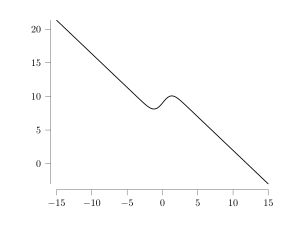
Is there a robust algorithm for this? My first thought was [IntervalRootFinding.jl](https://github.com/JuliaIntervals/IntervalRootFinding.jl), but I ran into an [issue](https://github.com/JuliaIntervals/IntervalRootFinding.jl/issues/225) [that MWE has `p = normcdf(z)`, which as a host of numerical problems on its own, see the values above).
---
### Author:  [@rveltz](https://discourse.julialang.org/u/rveltz)
#### Post date: [September 22, 2025, 2:26pm UTC](https://discourse.julialang.org/t/finding-all-zeros-of-a-univariate-function-on-the-real-line/132565/2 "2025-09-22T14:26:15Z")
ApproxFun?
---
### Author:  [@JonasWickman](https://discourse.julialang.org/u/JonasWickman)
#### Post date: [September 22, 2025, 3:18pm UTC](https://discourse.julialang.org/t/finding-all-zeros-of-a-univariate-function-on-the-real-line/132565/3 "2025-09-22T15:18:50Z")
Not a solution, but you should be able to restrict your search space by noting that if f = 0, then
z = C\_m + D\_mH
and since H \in [0,1] (since it’s a cdf), this means that the root z must be in the interval [C\_m, C\_m + D\_m] (if D\_m is positive) or [C\_m + D\_m, C\_m] (if D\_m is negative).
---
### Author:  [@rafael.guerra](https://discourse.julialang.org/u/rafael.guerra)
#### Post date: [September 22, 2025, 3:27pm UTC](https://discourse.julialang.org/t/finding-all-zeros-of-a-univariate-function-on-the-real-line/132565/4 "2025-09-22T15:27:25Z")
FWIW, you could use AccessibleModels.jl to explore the problem graphically:
```julia-auto
using AccessibleModels, IntervalSets
using GLMakie
using StatsFuns
struct makef{A, B, C, D}
Cm::A
Dm::B
Cf::C
Df::D
end
(m::makef)(z) = m.Cm + m.Dm * normcdf(m.Cf + m.Df * normcdf(z)) - z
amodel = AccessibleModel(makef(1., 1., 1., 1.),
( (@o _.Cm) => -100..100,
(@o _.Dm) => -100..100,
(@o _.Cf) => -100..100,
(@o _.Df) => -100..100,
))
fig = Figure()
obj, = SliderGrid(fig[1,1], amodel)
lines(fig[2,1], -100..100, @lift x -> $obj(x))
```
And if someone can add input text boxes to the example, it would be awesome.
---
### Author:  [@Tamas\_Papp](https://discourse.julialang.org/u/Tamas_Papp)
#### Post date: [September 23, 2025, 1:23pm UTC](https://discourse.julialang.org/t/finding-all-zeros-of-a-univariate-function-on-the-real-line/132565/5 "2025-09-23T13:23:32Z")
> [@JonasWickman](#):
>
> you should be able to restrict your search space
This is a great idea! I can take this further and define
y = \frac{z - C\_m}{D\_m}
and then my problem is
H(C\_f + D\_f H(C\_m + D\_m y)) = y
where we know that y \in [0,1] so there is a bracket already. Brent’s method from Roots.jl is pretty good on this, not as fast as Newton’s, but much more robust.
I am only struggling with precision issues where I am around the edges (y \approx 0 or y \approx 1).
> [@rafael.guerra](#):
>
> explore the problem graphically
Thanks, that is really helpful. Now I convinced myself that there is either a unique root or 3 roots. Life would be so much simpler if I got IntervalRootFinding.jl working on this problem.
---
### Author:  [@abulak](https://discourse.julialang.org/u/abulak)
#### Post date: [September 26, 2025, 10:23pm UTC](https://discourse.julialang.org/t/finding-all-zeros-of-a-univariate-function-on-the-real-line/132565/6 "2025-09-26T22:23:51Z")
Since the interval for `y` is bounded you can use `isolate_roots` form [GitHub - Joel-Dahne/ArbExtras.jl: Julia package with extra tools for Arblib.jl](https://github.com/Joel-Dahne/ArbExtras.jl) which will either _prove_ to you that all roots are isolated or indicate which ones were not.
You might define `normcdf` as:
```julia
julia> function normcdf!(out::Arb, x::Arb)
t = Arb(2, prec = precision(x))
sqrt2 = Arblib.sqrt!(t, t)
Arblib.inv!(t,t)
Arblib.mul!(t, t, x)
Arblib.hypgeom_erf!(out, t)
Arblib.add!(out, out, 1)
Arblib.div!(out, out, 2)
out
end;
julia> StatsFuns.normcdf(a::Arb) = (x = zero(a); normcdf!(x, a); x);
julia> normcdf(2) - normcdf(Arb(2))
[-1.3849763108389696060605952972944153160163339998695237096472e-18 +/- 3.28e-77]
```
note that to use `isolate_roots` you’d need to define `normcdf` also for `ArbSeries`, which I’m not familiar with; If you’re interested ask `@joeldahne` about this!